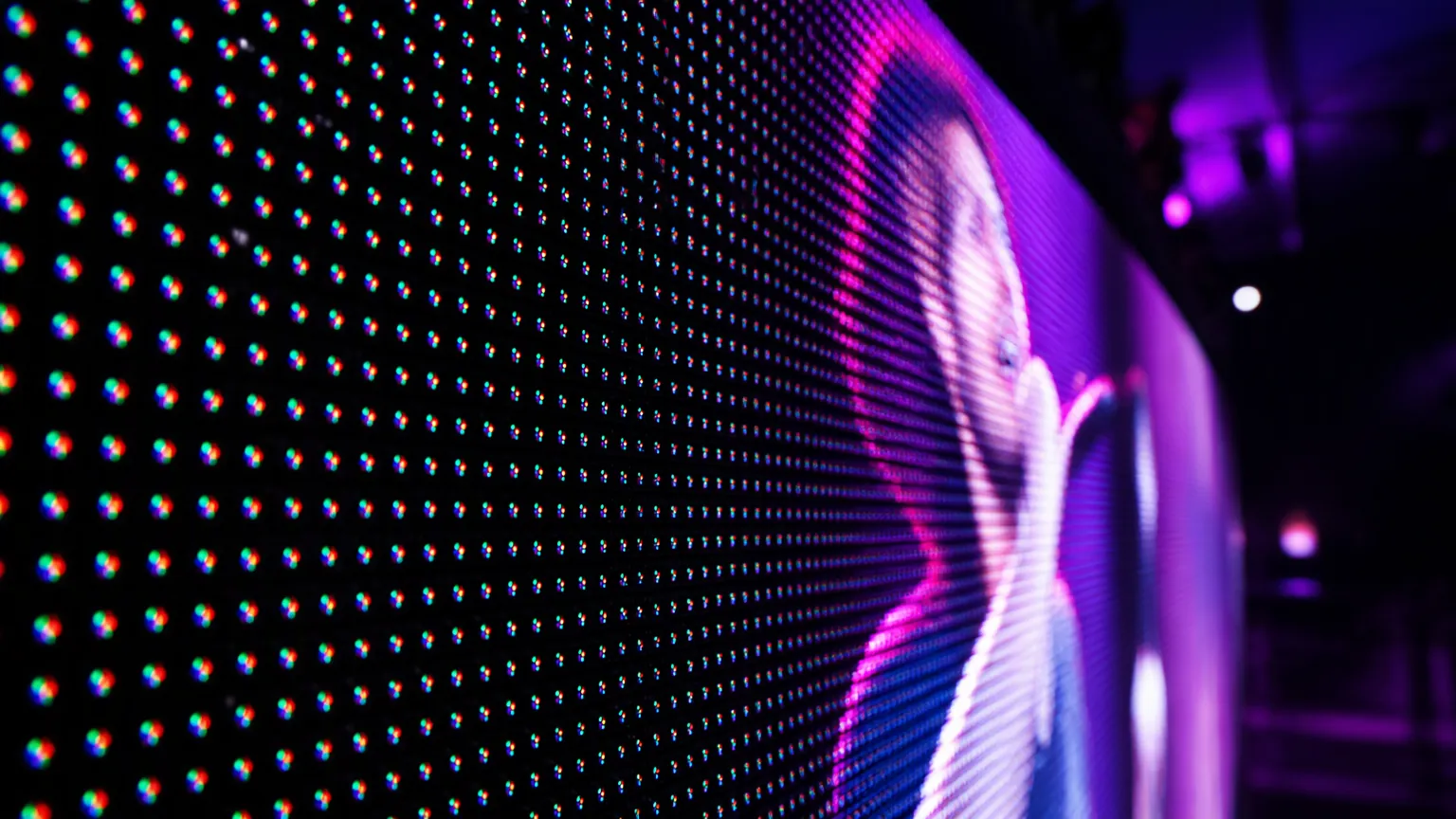
Every LED wall quote you will ever receive is really a negotiation about one number: pixel pitch. Understand it and you can spec a wall in five minutes. Ignore it and you will either pay for resolution nobody can see, or save money on a screen the front row photographs as a grid of dots.
- Minimum viewing distance (m) ≈ the pitch number. P2.6 looks clean from about 2.6 m back; P3.9 wants ~4 m.
- Optimal viewing distance ≈ 2 × pitch. This is where the image fully "locks in" (Barco's OVD rule).
- Design around the closest viewer who counts, not the average one.
- Event rental standard indoors is P2.6–P3.9; outdoors starts around P3.9–P4.8.
01 / DefinitionWhat the number means
Pixel pitch is the distance in millimetres between the centre of one LED pixel and the centre of the next. P2.6 means 2.6 mm apart. Everything else, resolution, cost, power draw, viewing distance, is a consequence of that one measurement. Halve the pitch and you roughly quadruple the pixels per square metre: a P2.6 panel packs about 147,900 px/m², while P3.9 manages about 65,700.
Concretely: a 3 × 2 m wall built from P2.6 panels resolves to roughly 1152 × 768 pixels, close to HD. The same wall at P3.9 gives you about 768 × 512. Same physical screen, noticeably different picture, noticeably different invoice.
02 / The chartThe pixel pitch chart
Two distances count. The minimum is where pixels stop being individually visible (roughly the pitch number, in metres). The optimal is where the image looks its best (roughly twice the pitch. The rule Barco publishes as OVD = 2 × pitch). Spec to the minimum; enjoy the optimal.
| Pitch | Pixels / m² | Min distance | Optimal distance | Typical use |
|---|---|---|---|---|
| P1.2 | ~694,000 | ~1.2 m | ~2.4 m | Broadcast studios, boardrooms, control rooms |
| P1.5 | ~444,000 | ~1.5 m | ~3 m | High end corporate, retail flagships |
| P1.9 | ~277,000 | ~1.9 m | ~3.8 m | Permanent indoor installs, lobbies |
| P2.6 | ~147,900 | ~2.6 m | ~5.2 m | Indoor events, weddings, DJ booths, ballrooms |
| P3.9 | ~65,700 | ~3.9 m | ~7.8 m | Large stages, outdoor rental workhorse |
| P4.8 | ~43,400 | ~4.8 m | ~9.6 m | Outdoor events, festival side screens |
| P6+ | ~27,800 | ~6 m | ~12 m | Stadium screens |
| P10 | 10,000 | ~10 m | ~20 m | Billboards, building scale signage |
03 / RealityWhy events break the textbook rules
Manufacturers picture viewers politely distributed across a room. Events don't work like that. At a wedding or a club night, people lean on the stage, crowd the DJ booth and hold phones a metre off the wall to film it. The closest regular viewer, not the average: is who you are designing for. That is why P2.6 became the indoor event standard: it is the pitch that survives a phone camera at one metre, which is where half of your content ends up anyway.
Nobody remembers the wall that was slightly too fine. Everybody photographs the wall that was too coarse.
04 / Beyond pitchThe specs people forget to ask about
Brightness (nits)
Indoor walls typically run 800–1,500 nits: plenty in a dim ballroom. Outdoor daytime events need 4,500–6,500 nits to fight the sun. Renting an indoor rated panel for an afternoon garden party is a classic way to show guests a black mirror.
Refresh rate and cameras
If the event is filmed, and every event is filmed, ask for ≥3,840 Hz refresh. Lower refresh walls flicker and band on camera even when they look fine to the naked eye. Fine pitch panels reduce moiré on camera, but refresh rate is the bigger offender.
Cabinet size and resolution math
Rental cabinets are often 500 × 500 mm or 500 × 1,000 mm, so walls grow in half metre steps. Your content resolution must map to the final pixel grid. A wall that lands at 1,152 pixels wide needs content rendered (or scaled by the processor) to exactly that, or you get soft scaling artefacts on text.
05 / MoneyWhere budgets go wrong
Finer pitch costs more per square metre, draws more power, adds weight and increases setup time. Overspeccing is the silent budget killer: a P1.9 wall for a stage where the front row stands 8 metres back is money set on fire, because at 8 m a P3.9 looks identical. Underspeccing is the loud one: guests at the booth photographing individual pixels on the couple's monogram. Run the chart against your closest viewer and the answer often picks itself. For the full engineering treatment, Planar's viewing distance white paper (PDF) remains the reference doc.
FAQPixel pitch questions
Is P2.6 or P3.9 better for events?
For indoor events where guests get close to the screen, booths, weddings, exhibitions, P2.6 is the safer standard. For larger stages and outdoor shows where the audience starts 4+ metres back, P3.9 delivers the same perceived quality for meaningfully less money, weight and power.
Can you mix two pixel pitches on one wall?
Technically possible, practically a bad idea: brightness and pixel structure won't match, and the seam between pitches reads clearly on camera. The accepted hybrid is different pitches on separate screens: fine pitch on the main wall, coarser on distant delay screens.
What pitch do I need for 4K content?
Divide your wall width in millimetres by 3,840 to get the pitch that resolves true 4K across it. A 5-metre-wide wall needs roughly P1.3 for native 4K, which is why most event walls run scaled HD instead, and why processor scaling quality counts for more than the content's nominal resolution.