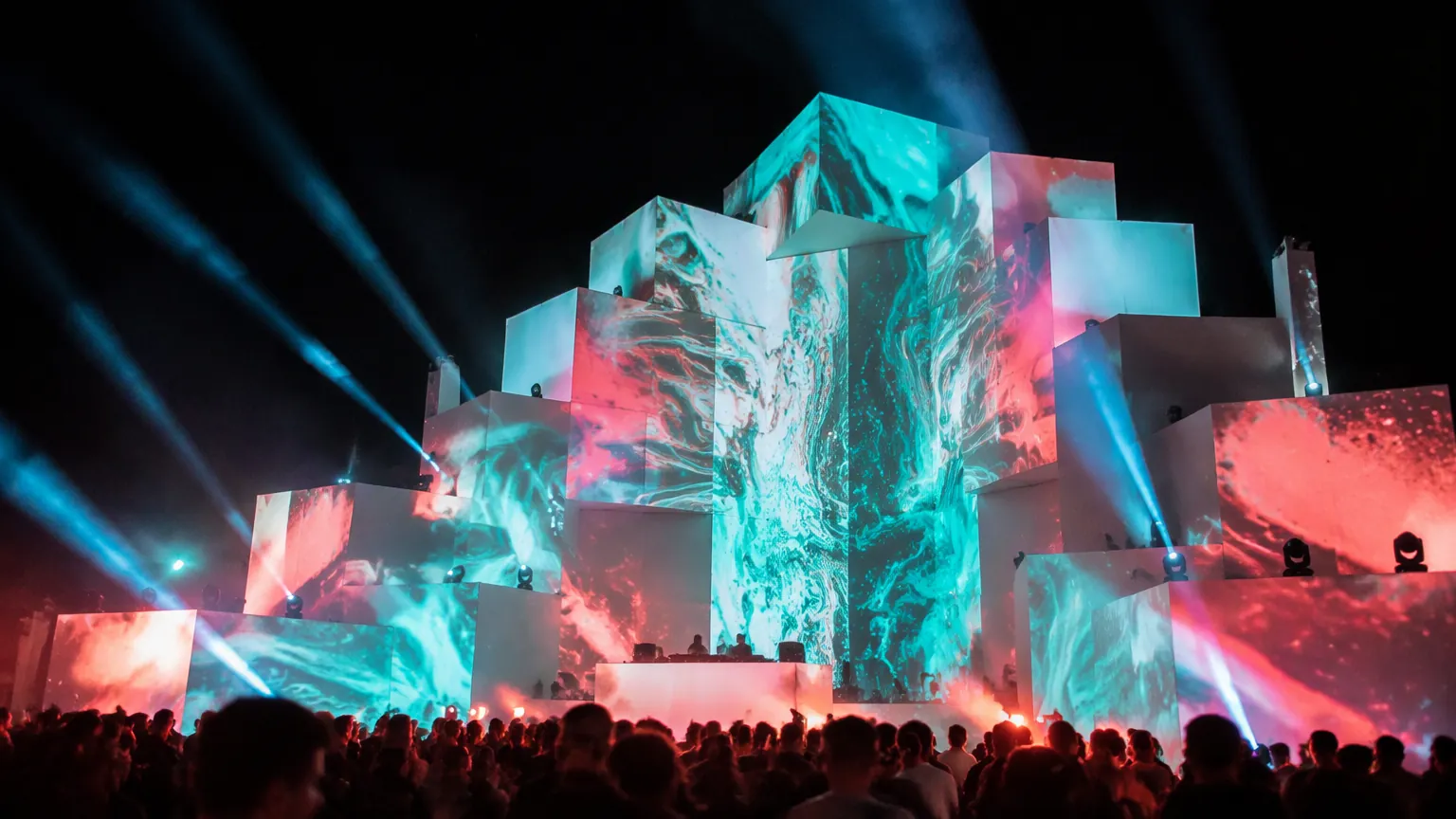
Projection mapping (or video mapping) means projecting content precisely onto an irregular surface (a car, a cake, a facade, a stack of cubes) so the light itself seems to change the object. The "mapping" is the software warping your content to fit the physical geometry, pixel by pixel. Done well, it's the highest wow per dollar effect in live events. Done casually, it's a blurry rectangle on a wall.
- Surface first. Light, matte, still. Everything else flows from it.
- Brightness: ~100 lumens per m² in a dark room, 300+ with ambient light, far more outdoors.
- Throw: the lens ratio decides where projectors can physically sit.
- Software: MadMapper, Resolume Arena or HeavyM do the warping.
- Content: bold lines and contrast win; fine text and skin tones lose.
01 / SurfaceRule one: the surface chooses you
Every mapping project starts with the object, not the gear. The ideal surface is light coloured, matte and motionless: white walls, purpose built scenic cubes, wedding cakes, plaster decor. Dark surfaces absorb your lumens (a black car needs a few times the brightness of a white one). Glossy and glass surfaces bounce the beam into the audience's eyes. Heavily textured surfaces, brick, foliage, drapes, eat fine detail; they want bold, chunky content or nothing.
And the surface must not move. A mapped object that shifts 10 cm mid show is suddenly wearing its projection like a bad Halloween mask. Map the bar facade, not the bar's sliding door.
02 / BrightnessLumens: the budget driver
Projector brightness is where quotes separate. The working rule of thumb for mapping:
| Environment | Lumens per m² | Example |
|---|---|---|
| Dark indoor room | ~100 /m² | A 3 × 2 m booth wall: a 5,000–7,000 lumen projector |
| Indoor with ambient light | ~300+ /m² | Same wall at a lit trade show: 15,000–20,000 lumens |
| Outdoor at night | 500–1,000+ /m² | Building facades: many 20,000–40,000 lumen laser units, stacked and blended |
Two forces fight you: ambient light and surface colour. City glow, emergency lighting and LED screens all wash out projection; the only cure is more lumens or darkness, which is why mapped shows schedule around sunset and negotiate every house light. For serious outdoor work, projectors are stacked (two units doubling brightness on the same area) and edge blended (many units tiling one giant canvas).
03 / PlacementThrow distance: where can the projector live?
The throw ratio: distance ÷ image width: decides projector placement, and placement is often the hardest logistical problem at an event. A standard lens (~1.5:1) needs 7.5 m of clear space to fill a 5 m wall; a short throw lens (0.8:1) does it from 4 m; an ultra short throw can sit almost against the surface. Rigs must avoid guest sightlines, catering routes and weather. Use a throw calculator ProjectorCentral maintains the reference ones: before you commit a venue layout, not after.
The most expensive words in projection mapping: "we'll just move the projector somewhere else on the night."
04 / SoftwareThe software stack
Three tools dominate event mapping, and we compare two of them in depth here:
- MadMapper: the specialist. Fast surface warping, mesh tools, LED mapping in the same app. The default for dedicated mapping jobs.
- Resolume Arena: the VJ standard; its advanced output handles mapping well when the show involves live mixed visuals.
- HeavyM: the beginner friendly way in, with sound reactive effects built in; ideal for first small installs.
The process is the same in all of them: photograph or survey the surface, build a template mask at projector resolution, design content for the template (not generic 16:9 video), then warp and line up on site until the virtual and physical surfaces lock. Lining up on site on a complex facade takes hours, not minutes, schedule it.
05 / ContentDesign for the object, not the screen
The mapping illusions that read across a room are built from contrast, edges and movement that follow the object's geometry: light crawling along real edges, surfaces appearing to crumble, outlines strobing. What fails: fine typography, faces, photographs, subtle gradients. All murdered by texture and viewing angles. The best mapped content is designed on the template from day one; repurposed brand video always looks like repurposed brand video.
06 / BudgetsWhat it costs, honestly
- Small install (wedding cake, DJ booth facade, product plinth): one 5,000–7,000 lumen projector, a laptop, HeavyM or MadMapper. A one person job, low four figures or less.
- Event feature (stage set, ballroom wall, car reveal): 10–20k lumens, proper lenses, media server, an operator for the show, mid four to low five figures.
- Building facade: many stacked 20–40k lumen laser projectors, blending, weather protection, permits, weeks of content production, five figures and up, and worth every cent when the content is good.
The pattern across all three: content and line up time cost more than hardware. Budget for the artist and the afternoon of focusing, not just the projector line.
FAQProjection mapping questions
Can I projection map with a home cinema projector?
For a small, dark room object (a cake, a booth, a single prop) yes, a bright home projector (3,000+ lumens) plus free mapping software trials is a legitimate first experiment. For anything guests photograph from a distance, or any room with ambient light, you'll need event grade brightness.
Does projection mapping work in daylight?
Effectively no. Direct sunlight delivers thousands of lumens per square metre: more than any projector stack can fight. Outdoor mapping is a night time art form; daytime events should look at LED walls instead.
How long does it take to set up a mapped show?
A single projector small install: half a day including content tweaks. A multi projector blended facade: one to three days of rigging, lining up and rehearsal. The content production takes far longer than either. Start it weeks ahead.
What is projection mapping?
Projection mapping fits video onto a real object, such as a building, a stage set or a wedding cake, so the picture follows its shape. Software warps the image to match the surface, which is why the content has to be made for that exact object.
Can I do projection mapping with my phone?
For a small test, yes. Phone apps can warp an image onto a box or a wall through a pocket projector. They run out of brightness and control quickly, so anything guests will photograph needs a proper projector and mapping software on a laptop.