Wireless microphones live in the gaps between TV stations, and every country slices those gaps differently. A frequency that's a legal, empty channel in Texas can be a live TV broadcast in London or a restricted band in Jakarta. Planning wireless for international events means knowing three things: what your gear can tune, what the destination allows, and what the venue's spectrum looks like on show day.
- US: TV channels 2–36 (below 608 MHz), plus slivers of the 600 MHz guard band and duplex gap.
- UK: license free Channel 70 (863–865 MHz); shared licence Channel 38 (606.5–613.5 MHz).
- SEA: no single rulebook: Thailand, Singapore, Malaysia and Indonesia each license differently. Wideband gear (470–694 MHz) plus local coordination is the professional answer.
- Always scan on site, coordinate with software, and budget time for it.
01 / United StatesThe US after the 600 MHz repack
The FCC's 2017 incentive auction sold the 600 MHz TV band to mobile carriers, and since July 2020 wireless mics have been out of it. Per the FCC's own guidance, what's left:
- TV channels 2–36: everything below 608 MHz, shared with TV broadcast, licensed or unlicensed depending on power and eligibility.
- Guard band 614–616 MHz: unlicensed use.
- Duplex gap 653–663 MHz: 653–657 MHz licensed, 657–663 MHz unlicensed, shared with white space devices.
- Outside TV bands: 902–928 MHz, 1920–1930 MHz, and parts of 2.4 GHz and 5 GHz for unlicensed systems.
Part 74 licenses (the kind that get interference protection) are reserved for broadcasters and venues/productions routinely running 50+ channels. Everyone else operates unlicensed, which legally means: no protection, and you must not cause interference.
02 / United KingdomThe UK: Channel 38 and Channel 70
The UK system is unusually tidy, and worth understanding because SEA regulators borrow from it. Two bands concern most productions, as summarised in the licensing overview and Ofcom's PMSE guidance:
- Channel 70 (863–865 MHz): license free, no paperwork, fits about 4 channels. This is where entry level and rental stock systems live.
- Channel 38 (606.5–613.5 MHz): shared licence from Ofcom, fits 10–12 coordinated channels. This is the professional band for theatres and touring shows.
- 173.8–175 MHz (VHF): legacy license free band; usable but congested and hissy.
- 1.8 GHz and 2.4 GHz: license free digital options that dodge the UHF squeeze entirely, at the cost of shorter range and crowded Wi-Fi airspace at 2.4.
03 / Southeast AsiaSEA: every border, a new rulebook
There is no ASEAN wide wireless mic rulebook. Each regulator, NBTC in Thailand, IMDA in Singapore, MCMC in Malaysia, SDPPI in Indonesia, sets its own bands, power limits and licensing. The regional pattern, though, is consistent enough to plan around:
| Band | Status in most of SEA | Practical note |
|---|---|---|
| 470–694 MHz (UHF TV) | Usable with authorization / local coordination | The professional workhorse; exact free channels vary by city and current TV assignments |
| 863–870 MHz | Short range device band in a few countries | Low power; fine for small rooms, risky for big stages |
| 2.4 GHz | License free everywhere | Crowded with Wi-Fi; digital systems only, keep antennas close |
| 1.8–1.9 GHz (DECT) | License free in much of the region | Underrated for corporate work: clean and uncrowded |
| US 600 MHz stock | Do not fly it | Fixed band US gear from the pre-2020 era is illegal and interference prone abroad |
Two consequences for touring productions. Buy wideband systems: a rack tuning 470–694 MHz can find legal, clean channels almost anywhere; a fixed band rack is a paperweight the moment it crosses a border. For anything beyond a few channels, hire local RF stock and a local frequency coordinator: established AV houses in Bangkok, Singapore and KL hold the licenses and know which channels are clean in their cities this month.
04 / CoordinationThe on site routine that prevents dropouts
Legality gets you permission; coordination gets you reliability. The professional sequence, anywhere on earth:
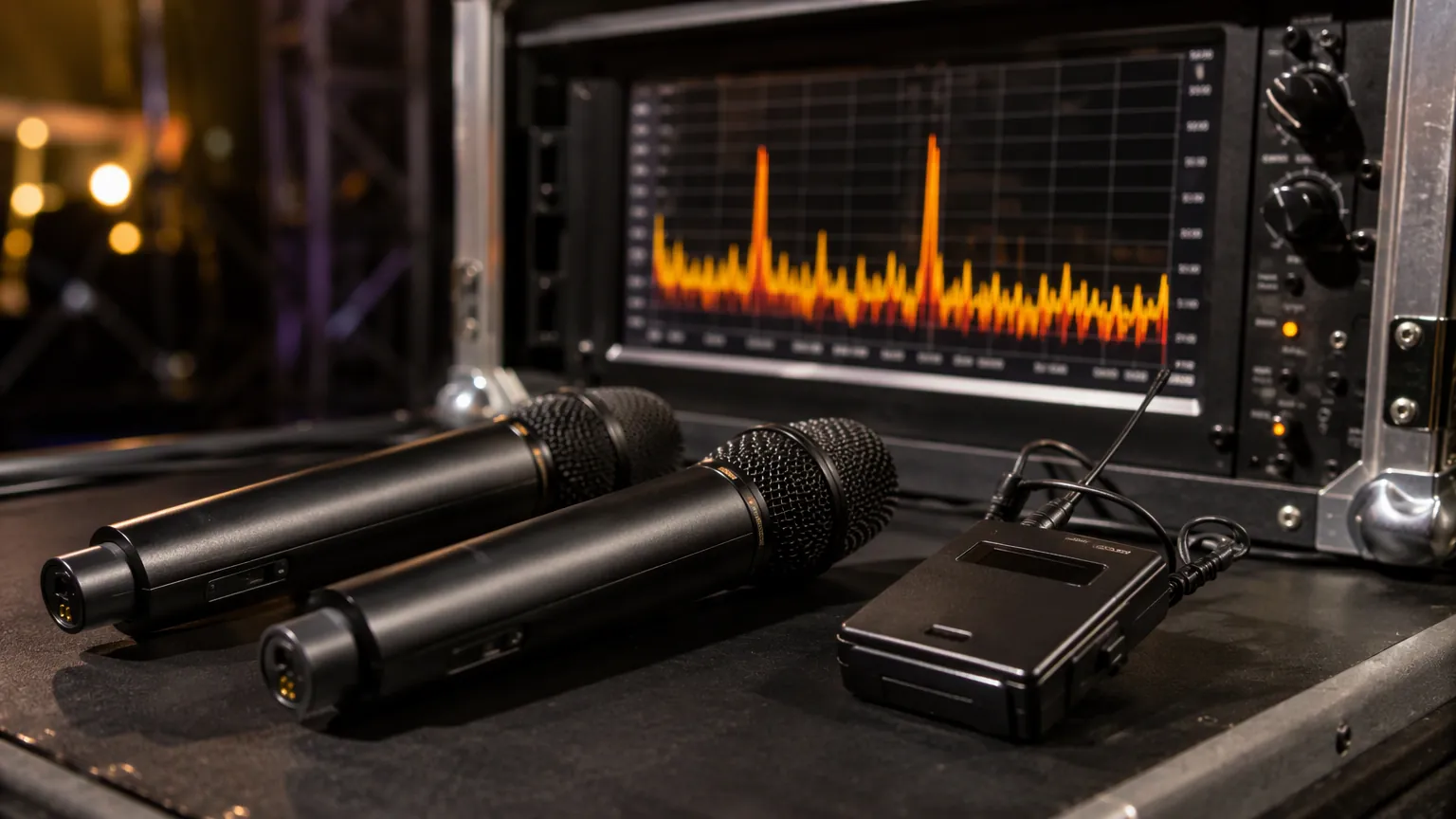
- Scan first. A spectrum scan of the venue, built into quality receivers or via coordination software, shows which channels are empty today, not on paper. Do it at show time, with the venue's own systems powered up.
- Calculate intermodulation. Mics don't just need free channels; they need channels that don't mathematically beat against each other. Tools like Shure's Wireless Workbench or Sennheiser's WSM compute compatible sets automatically. Never pick frequencies by hand beyond two channels.
- Antennas are half the system. Line of sight between antenna and stage, above head height, no metal barriers, antennas metres apart from each other. Past four channels, use proper antenna distribution and directional paddles.
- Rehearse with everything on. LED walls, video playback and comms all radiate. The scan at 2pm lies about the spectrum at 8pm.
Ninety percent of "wireless mic problems" are antenna problems. The other ten percent are a TV station nobody scanned for.
05 / The checklistBefore you fly the rack
- Confirm every unit's tuning range: wideband only for international work
- Check the destination regulator's current band plan (and any event licensing requirement)
- Arrange local licensed stock for channel counts above ~6
- Pack coordination software, a scanner, spare antennas and cabling
- Schedule scan and coordinate time in the production schedule: an hour, minimum
- Document final frequencies and keep a printed copy at front of house
Do this and Southeast Asia stops being RF roulette. The spectrum is busy, the rules are patchwork, but the physics is the same physics as home.
FAQWireless frequency questions
Can I use my US wireless mics in Thailand or Singapore?
Only if they tune to bands the local regulator allows: wideband 470–694 MHz systems often can, with local authorization and coordination. Fixed band US systems, especially anything in the old 600 MHz range, should stay home: illegal to operate and likely to eat interference.
How many wireless mics can run at once?
In a clean band with proper coordination: a dozen or more analogue channels, and 20+ with modern digital systems in wide tuning ranges. The limits are available spectrum and intermodulation math, not the hardware, which is why scanning and software coordination count for more than buying expensive mics.
Is 2.4 GHz a good escape from licensing?
It's license free worldwide, but it's where every phone, laptop and Wi-Fi router lives. For corporate ballrooms with controlled RF environments it works well; for festival stages surrounded by thousands of phones, UHF with coordination remains the professional choice.